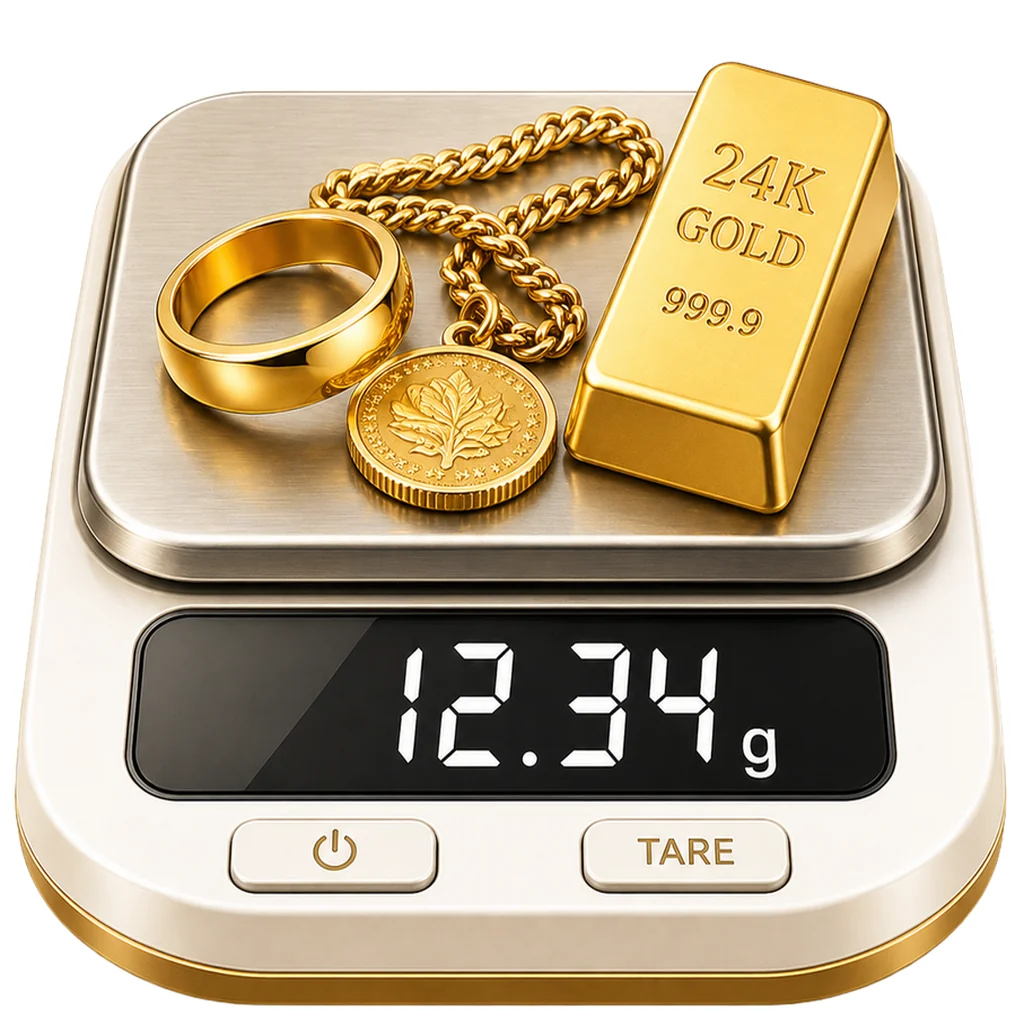
Karat × Grams = Price: The Pricing Cheat Sheet Jewelers Use
Every gold price quote is the same equation: pure gold weight times spot price times the buyer's markdown. Here's the math, written so you don't get talked out of money.
Walk into any jewelry transaction — buying or selling — and the price is one equation in a trench coat:
Pure gold weight × current spot price × markdown or markup = the number you see
This is true at the pawnshop, the refinery, the retail counter, and the Etsy listing. The participants pretend it’s more mysterious than that, but the math is fixed and you can run it in your head with five seconds of practice.
This is the cheat sheet.
The four numbers you need
To price any gold transaction, you need:
- Total weight (in grams)
- Karat purity (10k, 14k, 18k, 22k, 24k)
- Current spot price (in USD per gram)
- The buyer’s markup or seller’s markdown (a percentage)
Knowing the first three lets you compute the melt value — the absolute floor for any solid gold piece. The fourth tells you how the melt value translates to your actual offer or asking price.
The karat-to-purity table
This is the core conversion. Memorize it or write it on your wallet.
| Karat | Purity | Pure gold per gram of total |
|---|---|---|
| 10k | 41.7% | 0.417 g |
| 14k | 58.3% | 0.583 g |
| 18k | 75.0% | 0.750 g |
| 22k | 91.7% | 0.917 g |
| 24k | 99.9% | ~1.000 g |
European stamps (in parts per thousand): 417, 585, 750, 916, 999.
A 12g 14k chain contains 12 × 0.583 = 7.0g of pure gold.
The spot price reality
Gold spot price moves every minute during market hours. The number you need is “per gram, USD.”
In mid-2026, that’s typically in the $80-$95 per gram range, fluctuating with markets. Check kitco.com or any gold tracker app the morning of any transaction.
Spot is the wholesale market price for 24k pure gold delivered in bullion form. Everything else (jewelry, coins, scrap) trades at some discount to spot.
Melt value formula
Melt value = Pure gold weight × spot price
Examples (assuming spot = $90/g):
| Item | Total weight | Karat | Pure gold | Melt value |
|---|---|---|---|---|
| 14k wedding band | 5g | 14k | 2.92g | $263 |
| 18k engagement ring | 8g | 18k | 6.0g | $540 |
| 14k rope chain | 25g | 14k | 14.6g | $1,313 |
| 22k Indian bangle | 30g | 22k | 27.5g | $2,475 |
| 10k class ring | 12g | 10k | 5.0g | $450 |
| 1 oz Gold Eagle | 33.93g | 22k | 31.1g | $2,799 |
Melt value is the lower bound. No buyer should pay you less than the markdown they admit to (typically 60-95% of melt depending on where you sell).
The markdown table
This is what the buyer pays you, expressed as a percentage of melt value:
| Buyer | Typical markdown | When |
|---|---|---|
| Pawnshop, single piece | 60-75% | Jewelry under 30g pure gold |
| Pawnshop, multiple pieces | 65-80% | When negotiated |
| Cash-for-gold mail-in service | 50-65% | Convenient but lowest |
| Local coin dealer (for coins) | 92-97% | Recognized bullion only |
| Refinery direct | 88-95% | Usually requires 30g+ minimum |
| Auction house (for branded/antique) | varies above melt | When piece has provenance |
A 12g 14k chain (7g pure, $630 melt at $90 spot):
- Mail-in service offer: ~$315
- Pawnshop offer: ~$440
- Refinery offer (if you had quantity): ~$580
Same chain, different buyer = $265 spread. The buyer is not the only variable, but it’s the biggest one once weight and karat are established.
The markup table (for buying)
Going the other direction — buying jewelry — the markups stack from the spot price upward:
| Buyer pays | Markup over melt |
|---|---|
| Wholesale jeweler buying scrap | 0% (they pay spot or below) |
| Retail buyer at cost (factory direct) | 100-200% |
| Retail in mall jewelry store | 300-600% |
| Designer brand (Cartier, Tiffany) | 600-1500% |
| Auction with brand cachet | varies, sometimes infinite |
A wedding band that costs the wholesaler $200 in materials retails for $1,000-$1,400 at a mall jeweler. The metal hasn’t gotten more valuable. Brand, distribution, retail rent, sales commission, and the expectation of certain margins did the work.
When you buy retail, you pay all of that. When you sell to a pawnshop, you get the wholesale-side number plus their markdown. The gap is the “jewelry tax” people don’t realize they’re paying.
Two worked transactions
Transaction A: Selling an inherited 18k chain
- Weight: 22g
- Karat: 18k (stamped 750)
- Pure gold: 22 × 0.750 = 16.5g
- Spot: $90/g
- Melt: 16.5 × $90 = $1,485
- Pawnshop offer at 70%: $1,040
- Pawnshop offer at 75%: $1,113
- Refinery offer at 90%: $1,337
If you have one chain, pawnshop is your buyer. Aim for 75% by walking in with the math written down.
Transaction B: Selling a wedding ring you bought retail
- Weight: 5g
- Karat: 14k
- Pure gold: 5 × 0.583 = 2.92g
- Spot: $90/g
- Melt: 2.92 × $90 = $262
- Pawnshop offer at 65%: $170
- Original retail price: $1,400
The $1,400 you paid was 5x the melt. The jeweler’s markup was 80% of that price. When you sell, the markup is gone and you get something close to wholesale. This is normal and unavoidable. It’s not the pawnshop’s fault.
The lesson: jewelry is not an investment unless it’s branded, antique, or signed. Treat retail jewelry as consumption, not asset. If you want gold as an asset, buy bullion coins.
Quick mental math shortcuts
For grocery-store-speed estimation:
- 14k at $90 spot is ~$52 per gram of total piece weight
- 18k at $90 spot is ~$67 per gram
- 22k at $90 spot is ~$83 per gram
- 10k at $90 spot is ~$37 per gram
So a 10g 14k piece is ~$520 in melt. A 10g 18k piece is ~$670. A 10g 22k piece is ~$830. Walk in knowing this.
For pawnshop offers, multiply the melt by ~0.7 to get a likely first offer. Refineries multiply by ~0.9.
Where weight estimation matters
The whole equation depends on accurate weight. If you’re walking into a pawnshop with no scale, you’re trusting them. Most pawnshops are honest, but the ones that aren’t fail on weight because karat fudging is harder to argue.
Bring your own weight. A jewelry scale at home is $25, a phone camera estimate is free. Either gets you to the same place: knowing what’s on the counter before you let someone else weigh it.
Scale for Grams in Gold mode applies the karat × density math automatically. You can photograph a piece, get an estimated weight, eyeball the karat from the stamp, and run the equation in your head before you walk in.
For the deeper negotiation playbook on a single piece, see Pawnshop vs Refinery: Why Weight Beats Karat. For inherited boxes with multiple pieces, see Inherited Jewelry: How to Sort by Weight Before the Appraiser. For checking hollow vs solid construction (which can change melt value by 50%), see Gold Chain Hollow vs Solid Test. For coin authenticity by weight, see Gold Coin Real vs Fake.
The takeaway
Gold pricing is one equation. Once you can run it in your head, no buyer can talk you out of the math. Spot price is public, karat is stamped, weight is measurable. The only variable is the buyer’s markdown, and you can compare buyers.
The people who get ripped off are the ones who let the buyer do all the math. Don’t be one of them. Bring the numbers, run the equation, take the offer that matches.
Need to weigh something now?
Scale for Grams turns your iPhone camera into a pocket scale. Free to download.
Download on App Store