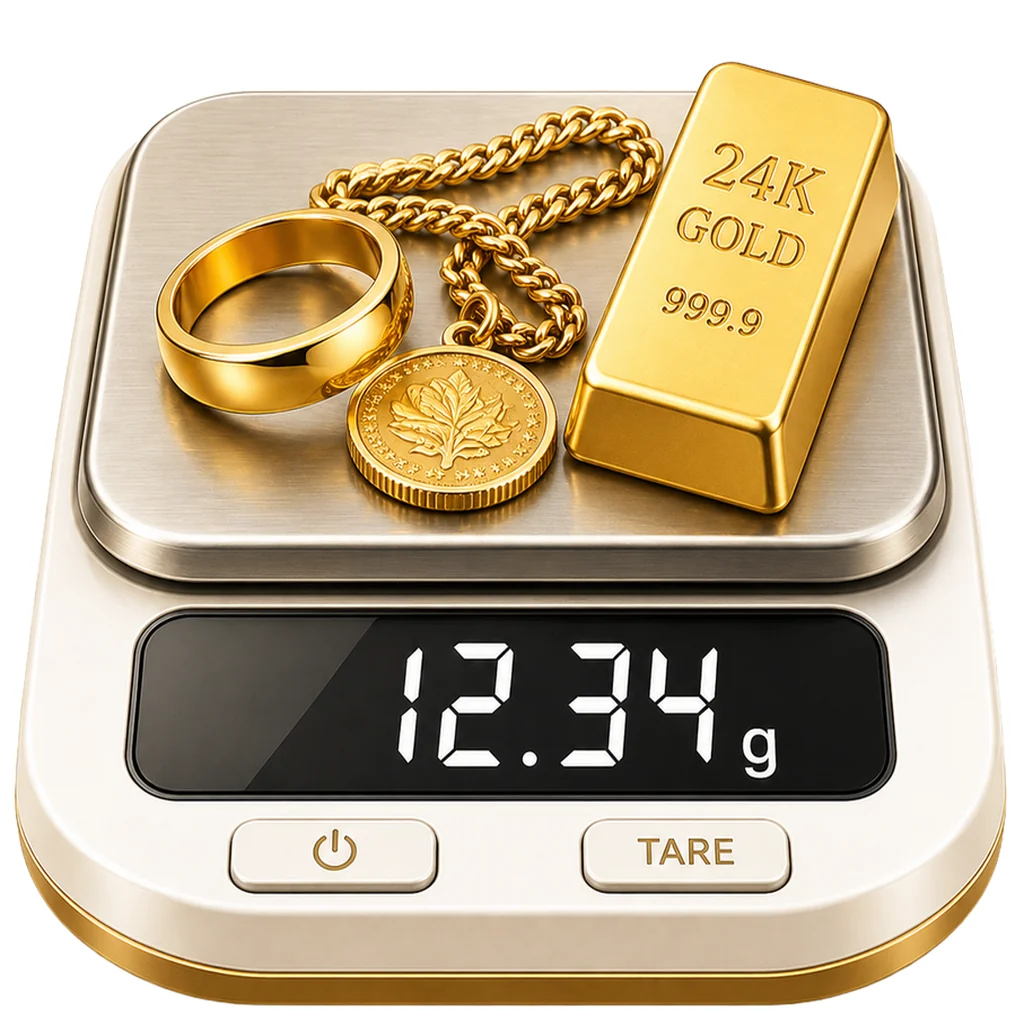
Pawnshop vs Refinery: Why Weight Beats Karat When You Sell Gold
Pawnshops pay you on melt value, but karat-only thinking leaves money on the counter. Here's how to weigh, calculate, and negotiate so you don't lose 20% on a sale.
Walk into any pawnshop with a gold chain and the first conversation will be about karat. “Is this 14k or 18k?” The pawnbroker squints, scratches the underside with a testing stone, and then quotes you a number.
The number they quote is almost never what your gold is actually worth. Not because pawnshops are scammers — most aren’t. The number is low because karat alone doesn’t price gold. Weight does. And most sellers walk in not knowing what their piece weighs, which means the pawnshop’s weight is the only weight in the room.
This is the field guide to fixing that. Read this before you sell, and you’ll either get a fairer offer or know which shop to walk out of.
The actual formula
Gold pricing for scrap (which is what pawnshops and refineries pay you on, regardless of what you call it) follows one equation:
Pure gold weight × current spot price × buyer’s markdown = your offer
Let’s break it apart.
Pure gold weight — the karat fraction times the total weight. A 10g 14k chain contains 10 × (14/24) = 5.83g of pure gold. The other 4.17g is alloy metal (copper, silver, nickel) and pawnshops pay zero for it.
Spot price — the live market rate per gram of pure gold. As of mid- 2026, this is in the $80–$95 per gram range and changes every minute. Check kitco.com or any gold tracker before you walk into a shop.
Buyer’s markdown — pawnshops typically pay 65–75% of melt value. Refineries pay 90–95% but only on quantities above a threshold (usually 1 oz / 31g of pure gold, sometimes higher). For the full pricing math including markup vs markdown across buyer types, see Karat × Grams = Price: The Cheat Sheet Jewelers Use.
So a 10g 14k chain at $90 spot:
- Pure gold weight: 5.83g
- Melt value: 5.83 × $90 = $525
- Pawnshop offer at 70%: $367
- Refinery offer at 92%: $483
The difference: $116 on a single chain. And that’s only if both are honest about your weight.
Where pawnshops underweigh
Not every pawnshop scams. But the structural incentive is to underweigh because they buy on weight and resell on whatever a customer is willing to pay. Underweighing your piece by 0.5g costs you ~$30 at current spot. Underweighing by 1g costs ~$60.
The three places weight gets fudged:
- The scale’s tare — placing the piece directly on a scale with a pre-tared dish that subtracts a few grams.
- The “we deduct for clasps and accents” — sometimes legitimate (a clasp may be steel, not gold), often inflated. A real clasp adjustment is 0.2-0.5g for a chain. Larger numbers should make you ask.
- The “this is 10k not 14k” — karat misclassification is the bigger move. Dropping you a karat tier reduces the pure-gold fraction by ~15%, which is harder to argue with than weight.
You can’t always check karat in the shop. You can always check weight.
How to weigh before you walk in
You need three numbers before you sell:
- Gross weight — the whole piece, in grams.
- Karat — stamped if you’re lucky (10k, 14k, 18k, 22k, 24k, or 750 for 18k European, 585 for 14k European, 916 for 22k).
- Spot price — current per-gram rate.
For weight, you have three options:
- Kitchen scale — anything 0.1g resolution and you’re set. $15 on Amazon.
- Postal scale — same accuracy class, often cheaper.
- Phone camera estimation — useful if you don’t own a scale. Won’t match a calibrated scale to the gram, but gets you within 1g on most rings, chains, and pendants. Enough to know if the pawnshop’s number is in the same neighborhood.
The hollow vs solid problem
This is where most pawnshop disputes happen and where the photo method matters most. A hollow gold chain has a thin gold shell around an air core. Same external dimensions as a solid chain, dramatically different weight. For the deeper diagnostic on telling them apart, see Is Your Gold Chain Hollow or Solid? A Photo Test That Actually Works.
A 50cm 5mm rope chain:
- Hollow 14k: roughly 8-12g
- Semi-hollow 14k: roughly 14-18g
- Solid 14k: roughly 22-30g
If a pawnshop tells you your chain is “thinner than it looks” and weighs 10g when you measured 22g at home, one of you is wrong. With your home weight in hand, you can call it. Without, you nod and lose $80.
For checking hollow vs solid by photo, look at:
- The clasp. Thick chain + tiny clasp = often hollow.
- The link cross-section. Puffy, rounded, “inflated” links = hollow. Flat, sharp-edged, dense = solid.
- How it drapes. Hollow chains hold their shape stiffly. Solid chains collapse like liquid.
A phone-based weight estimate gives you a sanity check the pawnshop’s number has to fit. If you photographed the chain and the app said 21g, and the pawnshop’s scale says 11g, ask them to weigh it again. Or walk.
Pawnshop vs refinery — when to choose which
| Quantity | Best buyer | Why |
|---|---|---|
| Single piece, < 5g pure gold | Pawnshop | Refineries usually have minimums |
| Multiple pieces, 5-30g pure gold | Multiple pawnshop quotes | Bidding works at this size |
| 30g+ pure gold | Refinery | The 20% spread on melt rate beats convenience |
| Antique, signed, or branded | Specialist auction house | Provenance can 5-10x melt value |
The biggest mistake is selling a branded or antique piece for melt. A Cartier love bracelet weighs about 30g, contains ~$2,500 in melt value at current spot, and sells at auction for $5,000-$8,000. Pawnshops will quote you melt and you’ll take it because you didn’t know.
The negotiation, in three lines
If your home weight matches the shop’s weight within 0.5g and the karat checks out, you have one move left: ask for the percentage. Pawnshops quote a dollar number; you do the math out loud:
“At $90 spot, 14k melt on this is about $X. You’re offering Y%. Can you do 75?”
Most pawnshops have room to move 5-10 percentage points. The ones who don’t will say so. The ones who pretend the math is wrong are the ones to walk out of.
A practical workflow
Before you sell:
- Weigh every piece at home, write the number down.
- Note the karat stamp.
- Check spot price the morning of.
- Calculate melt value per piece.
- Decide your floor (the lowest offer you’ll accept).
- Visit two or three shops. Use the highest as leverage.
If you don’t have a scale, Scale for Grams will get you within a gram on most jewelry — enough to spot a bad weight when it’s quoted. The Gold mode is built specifically around hollow vs solid detection because that’s where the offers go sideways.
Either way, walk in knowing what you have. The pawnshop’s job is to make money. Yours is to not lose more than you have to.
Need to weigh something now?
Scale for Grams turns your iPhone camera into a pocket scale. Free to download.
Download on App Store