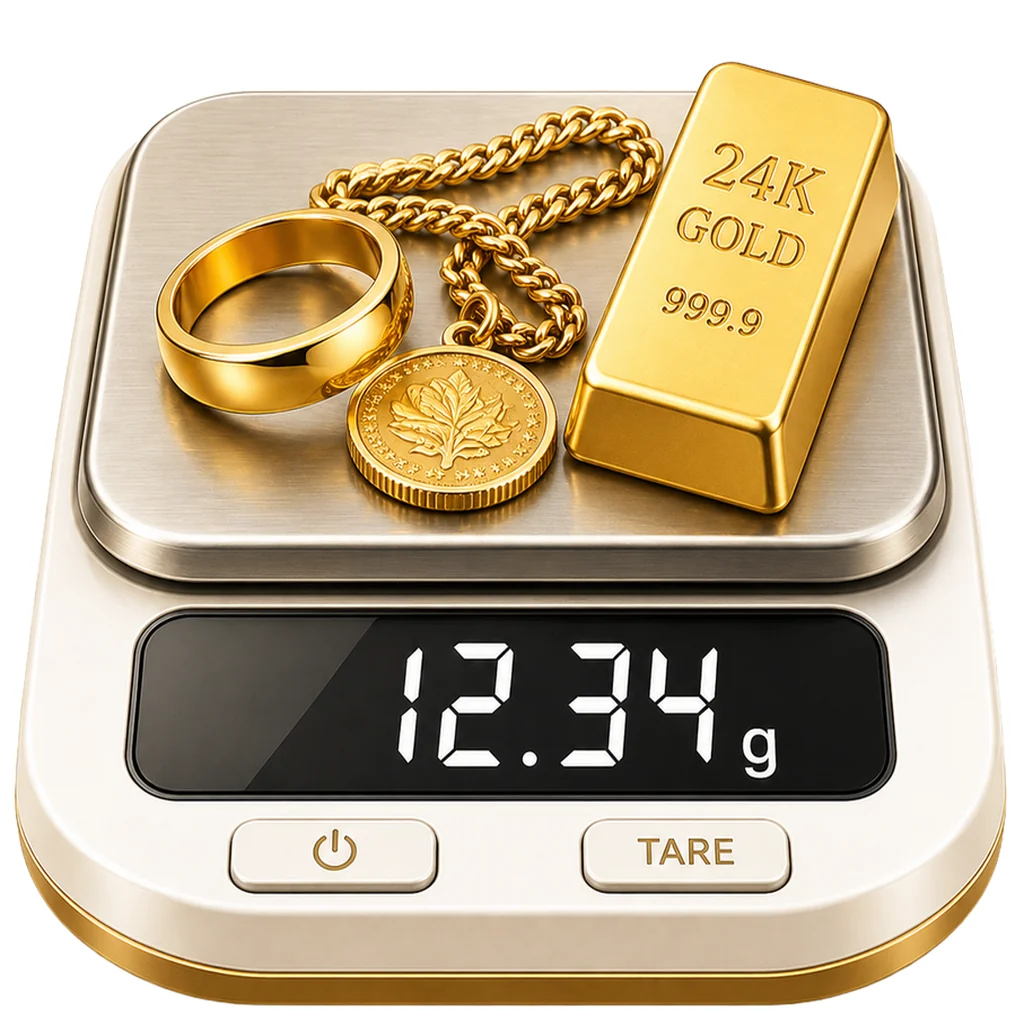
Inherited Jewelry: How to Sort by Weight Before the Appraiser Sees It
Walking into an appraisal with a tangled jewelry box gives the appraiser the upper hand. Here's the 30-minute home triage that puts you back in control.
A relative passes away. You inherit a jewelry box. You don’t know what’s real, what’s costume, what’s worth $20 and what’s worth $4,000. The emotional weight is heavier than anything on a scale.
The instinct is to dump it all on an appraiser’s table and ask them to sort it for you. Don’t. The appraiser is paid by you, but their incentive is to either buy the lot cheap (if they’re a buyer) or to charge for appraisal time (if they’re an appraiser). Either way, walking in without your own triage means walking out with an offer or invoice that neither one of you can verify.
This is the 30-minute home process for sorting an inherited jewelry box into “real, valuable,” “real, melt only,” “costume,” and “I have no idea.” After this, the appraiser is checking your work, not generating the answer.
What you need
- A flat surface with good light
- A magnet (small neodymium disc, not a fridge magnet)
- A magnifying glass or your phone camera at zoom
- A 0.1g jewelry scale OR a phone with a scale app
- Index cards or sticky notes
- Plastic bags or small jewelry bags
- Patience
The whole process takes 30-60 minutes for a typical inherited box of 20-50 pieces.
Step 1: The visual sort (5 minutes)
Empty everything onto the flat surface. Don’t sort yet — just look.
Note quickly:
- Stamps you can see at a glance (10k, 14k, 18k, 22k, 24k, 925, PT, GF, GP).
- Pieces with stones vs without.
- Pieces that are clearly costume (plastic, painted finish that’s worn off, lightweight in hand for the size).
- Anything signed by a brand (Tiffany, Cartier, Van Cleef, Bulgari, regional names).
This first look is just orientation. You’re not making decisions yet.
Step 2: The magnet pass (5 minutes)
Run a magnet over each piece, one at a time. Sort into two piles:
- Magnetic — base metal core. Costume or low-quality plated. Set aside, do not appraise. (One exception: some genuine antique pieces contain steel structural elements but are otherwise valuable. If the piece looks old and good, it goes in the “I have no idea” pile, not the costume pile.)
- Non-magnetic — could be gold, silver, platinum, brass, copper. Keep going.
Most inherited boxes have 30-50% costume. The magnet pass is the fastest way to clear it.
Step 3: The stamp read (10 minutes)
For every non-magnetic piece, find the stamp. Look on:
- Inside of rings (the band)
- Clasps of necklaces and bracelets (often hidden under a tab)
- Posts of earrings (close to where they enter the ear)
- Backs of brooches and pendants
Common stamps:
| Stamp | What it means |
|---|---|
| 10k, 14k, 18k, 22k | American karat marking, solid gold |
| 417, 585, 750, 916, 999 | European parts-per-thousand (= 10k, 14k, 18k, 22k, 24k) |
| 925 or STERLING | Sterling silver |
| PT or PT950 | Platinum |
| GF | Gold-filled (real gold layer over base metal) |
| GP, GEP, HGE, RGP | Gold-plated (thin layer, treat as costume) |
| 800 | European silver, lower than sterling |
| Pd | Palladium |
| Maker’s marks | Designer signature, can be a value multiplier |
Sort into stamped piles by metal: gold piles by karat, silver pile, platinum pile, gold-filled pile (separate — different value treatment), unstamped pile.
The unstamped pile is “I have no idea” — could be antique (often unstamped pre-1906 American), could be fake. Don’t try to decide yet.
Step 4: Weigh everything (10 minutes)
Get a weight on every piece. Use a 0.1g scale or a phone-camera estimate (close enough for triage purposes; appraiser will weigh properly later).
Write each piece’s weight on a sticky note or index card. Put the note with the piece. By the end, every piece has a weight tag.
Why this matters: inherited boxes go to appraisers in batches, and appraisers (or buyers) tend to weigh in groups, not piece-by-piece. If you have your own per-piece weights, you can verify the appraiser’s totals match yours. Discrepancies become questions you can ask.
Step 5: Compute melt value (5 minutes)
For every solid gold and silver piece, compute approximate melt value:
Pure gold weight × current spot price = melt value (gross)
Pure gold weight by karat:
- 10k: weight × 0.417
- 14k: weight × 0.583
- 18k: weight × 0.750
- 22k: weight × 0.917
- 24k: weight × 1.0
Spot price as of mid-2026 is in the $80-95 per gram range. Check kitco.com that morning.
For silver:
- Sterling (925): weight × 0.925 × silver spot
- Silver spot is roughly $0.90-1.10 per gram in 2026
Add up the melt totals. This is your scrap floor — the absolute minimum the gold and silver are worth. The appraiser cannot legitimately offer you less than this without lying about weight or karat.
Step 6: Identify the “more than melt” pieces
Some pieces are worth more than melt. These are the ones that need a proper appraiser, not a pawnshop. Flag for separate evaluation:
- Anything with a maker’s signature (designer brands, named jewelers from any era).
- Pieces with stones over 0.3 ct — diamonds, rubies, sapphires, emeralds. Big enough to value separately from the gold.
- Antique pieces with hand-engraving, niello work, micro-mosaics, or other obviously old craftsmanship.
- Watches of any kind. Even cheap-looking branded watches can have resale value.
- Pieces in original boxes with paperwork. Provenance multiplies value.
These go to a specialist auction house or a credentialed appraiser (GIA-certified for stones, NAJA for jewelry). Don’t take these to a pawnshop.
Step 7: The selling decision
You now have:
- A pile of solid gold pieces with weights and karat stamps
- A pile of silver with weights
- A pile of gold-filled (low value, optional sell)
- A pile of “more than melt” specialty pieces
- A pile of costume to keep, donate, or discard
For melt-only pieces:
- Under 30g pure gold total: sell to multiple pawnshops, take the best offer. See Pawnshop vs Refinery: Why Weight Beats Karat for the negotiation playbook.
- 30g+ pure gold: sell to a refinery. The 20% better rate beats the convenience tradeoff.
- Silver: refineries usually want 1+ pound sterling minimum. Pawnshops will take any quantity but at low percentages. Local coin dealers often pay better for silver than pawnshops.
For specialty pieces: get a credentialed appraisal first. Pay for one hour of an appraiser’s time ($150-300) before selling. The right appraisal can 5x the offer on a single antique piece.
A word on emotional triage
Inherited jewelry comes with emotional context that pure resale math ignores. Sometimes the right answer is to keep something even if it has no value. Sometimes the right answer is to sell something even if it has sentimental weight, because keeping it is making you sad.
The triage above gives you facts. What you do with the facts is separate. Do the math first, decide what to keep second. Mixing them leads to bad decisions in both directions.
Where the photo method fits
You don’t need to own a jewelry scale to do home triage. A phone camera estimate is good enough for:
- Sorting pieces into rough weight categories
- Spotting hollow vs solid chains (see Gold Chain Hollow vs Solid Test)
- Estimating per-piece weights for record-keeping
- Comparing your total to whatever the appraiser tells you
Scale for Grams in Gold mode handles the jewelry density variation that generic scales don’t. Photograph each piece on a plain background with a coin or credit card in frame, get a number, write it on the index card. Move on to the next one. The whole sorting process takes about 30 minutes without any equipment beyond what’s already in your pocket.
For pricing math once you’ve sorted, see Karat × Grams = Price: The Pricing Cheat Sheet Jewelers Use. For checking whether any one piece is real gold before melting, see Is Your Engagement Ring Real Gold? Three Tests in Under a Minute.
The appraiser will still need to verify, and should. But you’ll know whether their numbers make sense, which is the point of doing the work first.
Need to weigh something now?
Scale for Grams turns your iPhone camera into a pocket scale. Free to download.
Download on App Store