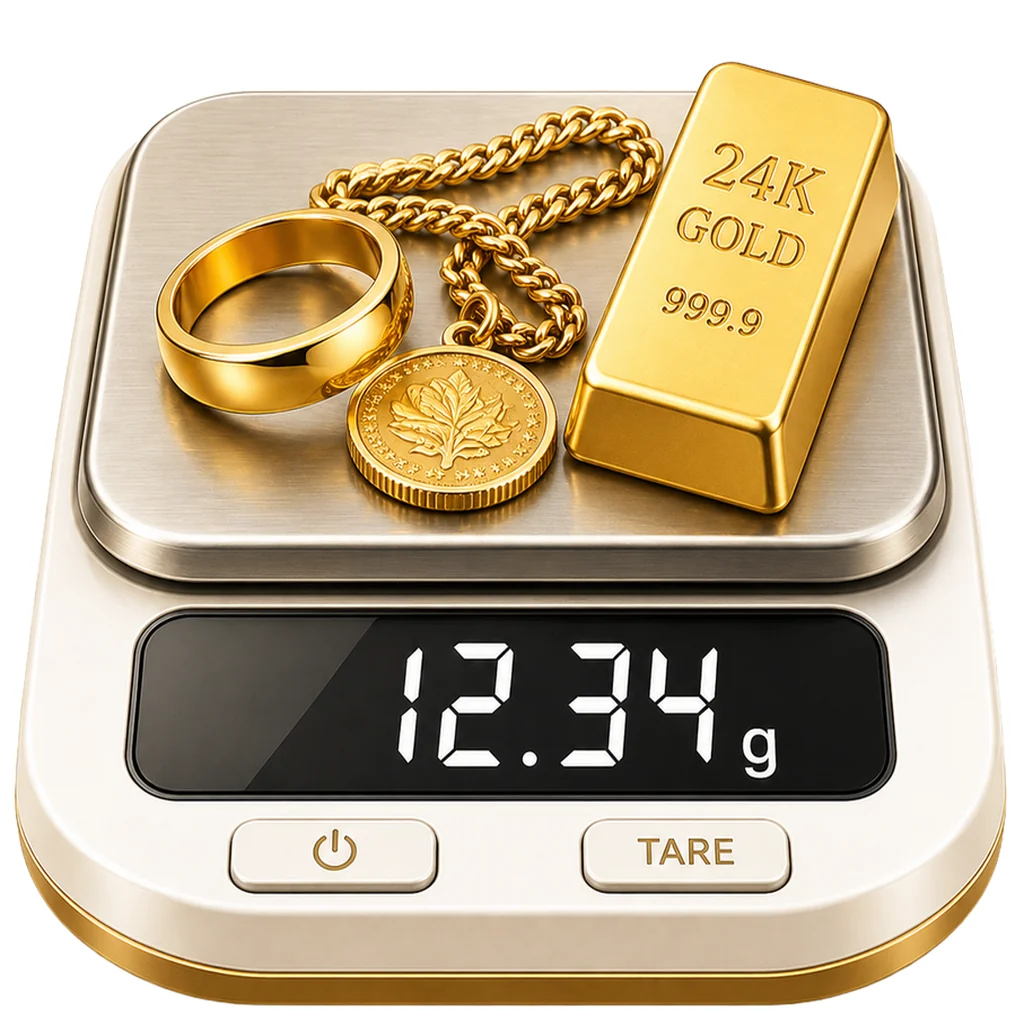
Gold Coin Real vs Fake: Why Weight Is the Most Reliable Single Test
Counterfeit gold coins are nearly impossible to make at the right weight. Here's the reference table and the simple weight-plus-dimensions test that catches almost every fake.
A counterfeit gold coin can fool the eye, the magnet, and even an acid test on the surface. What it cannot fool is a precision scale, because gold is denser than every metal a counterfeiter can realistically substitute.
This is why coin dealers and serious collectors trust weight more than any other single test. A real American Gold Eagle weighs 31.103 grams. A fake, no matter how well-made, weighs something else — usually 5-15% less because the substitute alloys are lighter than gold.
If you have a gold coin and want to know if it’s real, the answer is mostly in two numbers: the weight on a scale and a measurement of the diameter. Combined, they catch almost every fake on the market.
Why weight works so well
Gold is 19.3 g/cm³ in its pure 24k form. The closest metals by density:
- Tungsten: 19.25 g/cm³ (the only realistic counterfeit core)
- Lead: 11.34 g/cm³
- Silver: 10.49 g/cm³
- Copper: 8.96 g/cm³
- Brass: 8.5 g/cm³
For a counterfeiter to make a fake gold coin that hits the right weight AND dimensions, they need tungsten core with gold plating — because every other metal is dramatically less dense. A coin that looks like gold and weighs like gold but is actually lead is too thick or too wide. A coin that’s brass with gold plating and the right dimensions is too light.
Tungsten-cored fakes do exist and are the only counterfeits that defeat a simple weight check. They’re rare on common bullion (American Eagle, Krugerrand, Maple Leaf) and more common on private mint pieces where weight standards are less rigid. They also fail on precise diameter and ring tests, which we’ll get to.
The reference table
Memorize the weight of any coin you collect. For everything else, look it up before testing. The weight tolerances are tighter than people realize — coins should be within 0.05g of spec.
| Coin | Pure gold weight | Total weight (with alloy) | Diameter |
|---|---|---|---|
| American Gold Eagle 1 oz | 31.103 g | 33.93 g | 32.7 mm |
| American Gold Buffalo 1 oz | 31.103 g | 31.103 g (24k pure) | 32.7 mm |
| Canadian Maple Leaf 1 oz | 31.103 g | 31.103 g (24k pure) | 30.0 mm |
| South African Krugerrand 1 oz | 31.103 g | 33.93 g | 32.6 mm |
| Austrian Philharmonic 1 oz | 31.103 g | 31.103 g (24k pure) | 37.0 mm |
| British Sovereign | 7.323 g | 7.988 g | 22.05 mm |
| British Half Sovereign | 3.661 g | 3.994 g | 19.3 mm |
| Turkish Tam Altın (full) | 6.6 g | 7.216 g | 22 mm |
| Turkish Yarım Altın (half) | 3.3 g | 3.608 g | 18 mm |
| Turkish Çeyrek Altın (quarter) | 1.65 g | 1.804 g | 14 mm |
| Cumhuriyet Altını | 6.604 g | 7.216 g | 22 mm |
| 1/4 oz American Eagle | 7.776 g | 8.483 g | 22.0 mm |
| 1/10 oz American Eagle | 3.110 g | 3.393 g | 16.5 mm |
| Mexican 50 Pesos | 37.5 g | 41.666 g | 37 mm |
The American Eagle and Krugerrand contain alloy (copper and silver) which is why their total weight exceeds the pure gold weight. The Buffalo, Maple Leaf, and Philharmonic are 24k pure, so their total equals their pure gold content.
The basic test
You need:
- A 0.01g scale (jewelry scale, ~$25)
- A digital caliper or ruler (~$10)
Steps:
- Weigh the coin. Compare to the spec total weight.
- Measure the diameter at two perpendicular points.
- Measure the thickness at two points (some coins have a reeded edge, measure the flat part).
- Compare diameter and thickness to spec.
If all three match within tolerance, the coin is almost certainly real.
Tolerances:
- Weight: within 0.05g (0.15%) of spec
- Diameter: within 0.1mm of spec
- Thickness: within 0.05mm of spec
A fake gold-plated brass coin that weighs the right number is geometrically impossible without tungsten core. If your coin’s weight matches and the dimensions match, it’s real or it’s a high-end tungsten counterfeit (rare).
The ring test
Real gold coins, especially older ones, have a specific ring sound when balanced on a fingertip and tapped lightly with another coin. Tungsten fakes ring differently because tungsten is harder than gold and damps sound differently.
This test takes practice and is harder to describe than to do. Find a coin you know is real, ring it, then ring a coin you suspect. The difference is audible to anyone who’s listened a few times. It’s not proof on its own, but combined with weight and dimensions, it closes the loop on tungsten-core fakes.
Why pawnshops trust weight
A pawnshop offering on a gold coin is mostly weight-driven, not appearance-driven. They’ll often skip a karat acid test on a recognized coin because the weight + diameter check is faster and more reliable.
This works in your favor as a seller. If you bring in a real coin that matches spec, the conversation is short and offer is fair (typically 90-95% of melt value for recognized bullion, much closer to spot than jewelry gets).
If you bring in a coin that doesn’t match spec, the conversation is also short — they say no. The dispute, if any, happens at home before you go in, not at the counter.
What about non-bullion coins
For numismatic coins (collectible value above melt), weight is just one input. A 1907 St. Gaudens Double Eagle has roughly the same gold content as a modern American Eagle, but the collectible coin can sell for $2,500-$10,000+ depending on grade, while the modern bullion sells for melt + 3%.
Don’t sell numismatic coins to pawnshops. Take them to a coin dealer or auction house that grades. PCGS or NGC slabbed coins (already graded and sealed) sell at recognized market prices and are easier to move.
For non-slabbed coins you’re unsure about, a coin dealer can grade in five minutes. Pay for that opinion before you sell.
Where photo estimation fits
You don’t need a precision jewelry scale to do the basic weight check. A phone camera estimate is precise enough to flag obvious fakes. A coin spec’d at 31.103g that the phone estimates at 28g is suspicious. A phone estimate of 31.5g on the same coin is consistent with real.
For final verification before selling, get a precision scale or visit a dealer. The phone estimate is for the moment when someone offers you a coin at a flea market and you have ten seconds to decide whether to look interested.
Scale for Grams in Gold mode handles coin weight estimation reasonably well — the math is simpler for coins (consistent shape, known density category) than for jewelry. Photograph the coin on a plain dark surface with another known coin (a quarter is fine) for scale reference. The estimate catches obvious fakes; the precision scale catches everything else.
For the math on what your real coins are worth at current spot, see Pawnshop vs Refinery: Why Weight Beats Karat and Karat × Grams = Price. The same logic applies to coins, with the bonus that bullion coins have more transparent pricing than scrap jewelry. For the same weight-and- density approach applied to rings instead of coins, see Is Your Engagement Ring Real Gold?.
A practical workflow
If you have a coin and want to know if it’s real:
- Look up the spec weight and diameter.
- Weigh and measure.
- Compare to spec.
- Ring test.
- If still uncertain, take it to a coin dealer for a 60-second visual and weight check.
Most fakes fail step 2 immediately. The few that pass step 2 (tungsten cores) usually fail step 3 (diameter) or step 4 (ring). The combination catches over 99% of counterfeits.
Real coins are easy to verify. Fake coins are hard to make and impossible to make perfectly. The math doesn’t lie about gold.
Need to weigh something now?
Scale for Grams turns your iPhone camera into a pocket scale. Free to download.
Download on App Store