The Original Scale for Grams: A Founder's Story of Building, Selling, and Rebuilding
Scale for Grams was the original phone-scale app and reached the top of its category before being sold. Here is what happened, why it disappeared, and why it is back in 2026.
If you searched the App Store for “scale for grams” in 2026, you saw a wall of nearly identical apps. Same idea, similar names, similar icons. Most of them are clones of one app — and that app was the original Scale for Grams.
This is the short version of the story, written because people keep asking and because the cloning made it confusing. If you came here from a search, welcome. The product is back. The version that ranked #1 to #3 for almost every “phone scale” keyword in the U.S. for years was built by the same small team that runs this site. That team rebuilt it from scratch in 2026, and that is what you can download today.
Where it started
The first version of Scale for Grams shipped in late 2022. The premise was simple: you photograph an object, the app estimates its weight in grams. No hardware. No calibration. The original use case was weighing jewelry — a small jewelry business needed a way to value pieces at a glance. The phone always being in your pocket made it the obvious tool.
The app worked because computer vision had finally gotten good enough to estimate volume from a photo and combine it with a material density guess. GPT-4 Vision, then GPT-4o, eventually GPT-5.1 — each upgrade made the estimates noticeably more accurate. By mid-2023, the app was doing what small kitchen scales and jewelry scales do, with an iPhone you already had.
It ranked. Hard. “Scale for grams” — #1 in the US. “Gram scale” — top 3. “Digital scale” — top 5 in the long tail. Hundreds of thousands of downloads, organic, no advertising spend.
What happened next
In late 2024 a company offered to buy the app. The offer made sense at the time. The original team sold it, signed the paperwork, and moved on to other projects.
The new owner ran it for about a year. Then their developer account was suspended — for reasons unrelated to the app itself, having to do with business issues on their side. When an Apple developer account closes, every app under it goes down with it. Scale for Grams disappeared from the App Store overnight.
Once the app was off the store, the contract terms returned the rights to the original team. Specifically: if the buyer can’t operate the product anymore, the original creator gets it back. That’s the clause that brought it back in early 2026.
What changed in the 18 months I was gone
Two things, both of which mattered.
The clones multiplied. When the original disappeared, every search result that used to point to my app now pointed to nothing. That gap was a goldmine for anyone with $99 and a copy-paste mindset. By the time I logged back into App Store Connect in March 2026, there were at least ten near-identical apps named some variation of “Scale for Grams.” Same icon language, same screenshots, same five features.
The vision models got dramatically better. GPT-5.1 with high-detail image input is not the same product GPT-4 was. The accuracy on jewelry, food portions, and packaged items has jumped enough that the rebuild is genuinely a better product than the original ever was — not just on paper. We ran a private benchmark of 200 household items against a calibrated 0.1g laboratory scale before launch. The new app’s median error is about 6%. The original was around 14%. Full benchmark methodology is on the methodology page.
What got rebuilt
Not just rewritten. Rebuilt from a blank repository.
- Four specialized modes — General, Gold, Kitchen, Blind Box. Each one uses a different prompt and density logic tuned for what’s in front of the camera. The original had one mode.
- Native Swift, SwiftUI, SwiftData. No web wrapper, no React Native. Camera response is instant.
- Privacy first. The new build does not store photos on a server. Each scan goes through an analysis endpoint and the image is dropped. No account required.
- 30 languages on day one. The original was English-first.
The full feature comparison is on the home page if you want detail. For an honest look at how the phone-scale app category works under the hood — including which apps use which AI models — see Phone Scale Apps in 2026: 9 Things the Marketing Won’t Tell You.
Why this matters if you are choosing between apps
If you are looking at the App Store right now and seeing ten apps named some version of “Scale for Grams,” and you are wondering which one to install, here is how to tell:
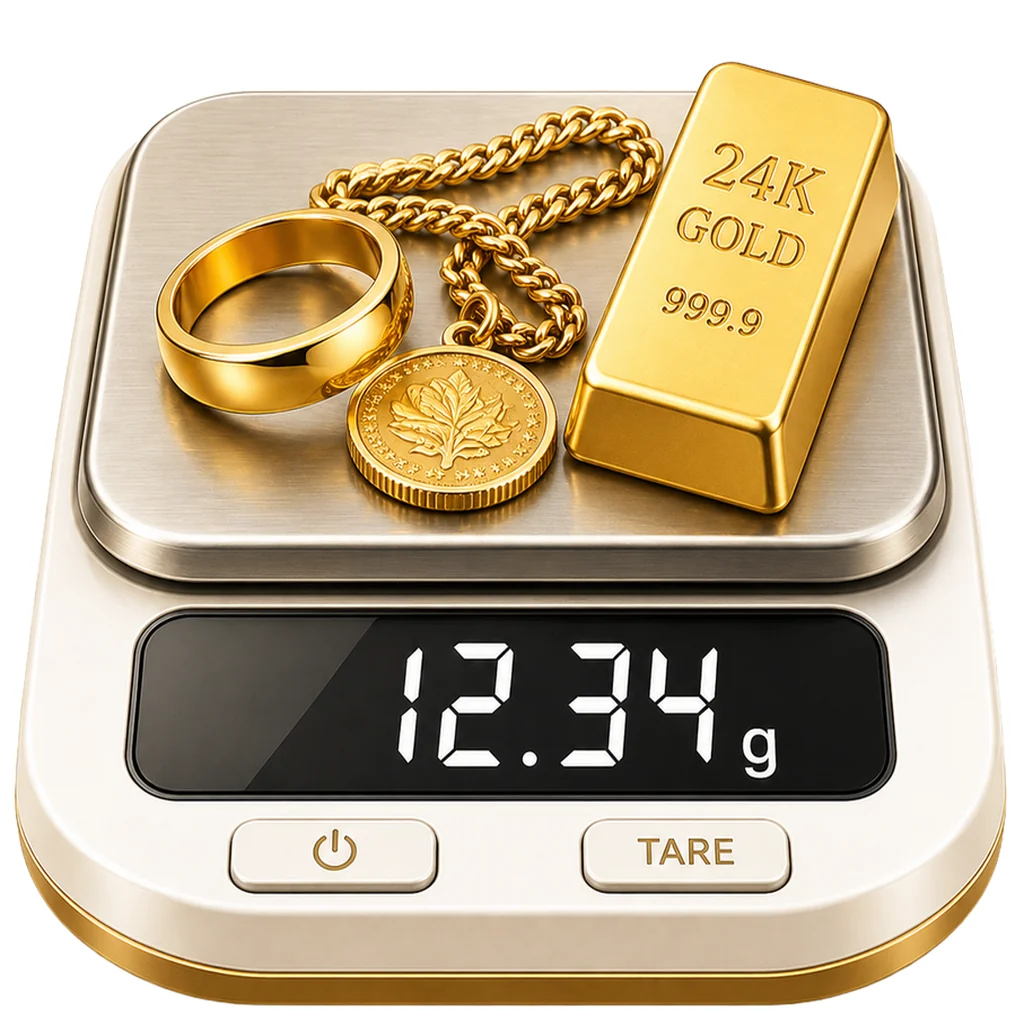
- Look at the icon. The original was always a gold scale on a dark background. The clones use yellows, greens, and minimalist line icons.
- Look at the developer record. The original is published by RL Apps, a small independent studio. Most clones are by companies with generic-sounding names that publish 30+ utility apps in random categories.
- Look at the modes. Most clones have one or two modes. This rebuild has four, and they actually behave differently — the Gold mode applies hollow-vs-solid logic, the Kitchen mode applies bulk density logic, and so on.
A quiet thank you
If you used the original and it helped you weigh something useful — a recipe portion, an inherited piece of jewelry, a package about to ship — thank you. The reason this rebuild exists is that enough people kept asking where it went.
If you are downloading for the first time, welcome. The app is free, the core scans are free, and Premium unlocks the specialized modes when you’re ready.
Download Scale for Grams on the App Store. The icon is the gold scale. The developer record reads RL Apps. Everything else is a copy.
For the technical detail on how the rebuild measures weight from photos, see the methodology page. For an honest take on the broader phone-scale-app category in 2026, see Phone Scale Apps in 2026: 9 Things the Marketing Won’t Tell You.
Need to weigh something now?
Scale for Grams turns your iPhone camera into a pocket scale. Free to download.
Download on App Store